
Vantage Point Contemporary is an art blog that focuses on artists, artist groups, small galleries, art associations, and other art spaces that are generally underrepresented in art reporting. Vantage Point Contemporary also covers major art fairs such as Art Basel, where we maintain a focus on smaller galleries and artist-run spaces.
Vantage Point Contemporary is directed and curated by the Joas Nebe.
Joas Nebe is an artist, curator, and academic with a background in psychology, media studies, literature, and theatre from the University of Hamburg. After graduating, Nebe lectured on film analysis at Hamburg University and analyzed advertising campaigns for Reemtsma. Since 2000, he has worked as an artist and freelance curator, with projects shown in Berlin, Milan, and Tehran.
Cao Fei: Testimonies To The Near Future
first solo exhibition of Chinese media artist Cao Fei in Europe
The Kunstmuseum Basel presents the first major solo exhibition in Europe of Chinese media artist Cao Fei (born 1978), whose formative years coincided with the cautious economic opening under Deng Xiaoping and whose artistic imagination bears traces of semi-legal Western imports alongside early imitations of Western consumer goods and their visual language. Growing up amid such hybrid material cultures, Fei began producing Hip Hop videos in the early 2000s — projects filmed both in Chinese cities (Guangzhou, Fukuoka) and abroad (Sydney, New York) with members of local Chinese diasporic communities — in which workers from diverse professions perform choreographies to hip hop beats: a police officer accompanied by a shackled prisoner, a shopkeeper posed before a storefront, and so on; the installation “Hip Hop” thereby pursues the transborder diffusion of Western pop culture.

In Cosplayers (2004) Fei stages the playful appropriation of anonymous urban spaces — a motorway ring, a canal — by adolescent cosplayers, a youth counterculture around the turn of the millennium in China; the work’s documentary framing intensifies the contrast between sprawling, concreted residential blocks and the flamboyant fantasy costumes that seem to have leapt from manga and anime panels.

Filling the entire museum building on the Rhine, the exhibition is organized by the artist into distinct zones conceived as “districts”: The Street (Hip Hop), The Park (Cosplayers), The Factories (Asia One), The Cinema (Nova, La Town), The Playground, The Office (RMB City), among others; visitors receive a printed map upon entry for orientation, while signage in corridors and at stairwells points toward each district much like wayfinding systems in airports or train stations.

Within The Cinema three feature films by Fei screen. La Town (2014) reads as an interpretation of Alain Resnais’s Hiroshima Mon Amour: an off-screen female voice recounts to an off-screen male voice a life, emotions and a place alternately identified with a person and with a geographic locale; images composed from stop-motion toy-train figures stage urban tableaux — the arrival of a high-ranking politician, a welcoming chapel, an intimate bedroom scene, people gathered in a garden, a strip club above a movie theater — followed by protest, burning wrecks, supermarkets, an industrial complex in flames; the film concludes with a visit to a “Museum of Night,” where fragments of preceding events are presented in glass cases and on pedestals as exhibited objects, so that latent urban violence becomes assimilated through musealization rather than confronted, and the framing narrative’s reference to Hiroshima Mon Amour establishes a hermeneutic premise suggesting that memory of catastrophe permeates everywhere.

The second film, the 100-minute Nova (2019), unfolds a temporally non-linear love story threaded between China’s communist past and the Soviet Union: in the 1950s and 1960s a team of Russian scientists is meant to assist Chinese counterparts in creating a world-market-capable computer, during which a romance blossoms between a Russian researcher and a Chinese engineer, while in a vaguely located future their son progressively uncovers traces of that history; although the piece melds genres — historical drama and science fiction — its development follows familiar genre topoi.

Similarly anchored in recognizable narrative patterns, Asia One (2018), assigned to The Factories, depicts two young human supervisors and an AI robot overseeing an unmanned, fully automated logistics warehouse; human connection proves elusive until a malfunction sends conveyor belts awash with fruit, discipline briefly collapses, one attendant casts off a uniform and kicks pomelos through the hall — a moment in which playfulness, here framed as an essential human faculty, reasserts itself.

From a middle period, RMB City (2007–2011), shown in The Office, represents Fei’s experiment within Second Life, an early metaverse, where programmers constructed an artificial city whose economy operated and where participants could purchase land and trade; RMB, shorthand for renminbi, names a “city of money,” and the project, conceived from the outset as a two-year endeavor, terminated as planned in 2011, remaining accessible today only in archived form.
RMB City functions as a behavioral experiment probing the underlying structures of economy and social life by rendering complex urban systems in a vivid, visually seductive register; Fei’s stance throughout the project tends toward optimism and genuine curiosity about how such systems operate.
Regarded now as one of the early works of net art, RMB City exemplifies a strand of practice in which play, simulation and infrastructural critique intersect.
Cao Fei’s honours include the SCAD deFINE ART prize (2024) and the Deutsche Börse Photography Foundation Prize (2021); nominations include the Hugo Boss Prize and the Future Generation Art Prize (both 2010), while awards from the China Contemporary Art Award (CCAA) designate Fei as “best artist” in 2006 and again in 2016.
Cao Fei: Testimonies To The Near Future
30th May - 11th October 2026
Kunstmuseum Basel, Switzerland
OPENINGHOURS GEGENWART
Tues–Sun 11am–6pm
Mon closed
CONTACT
Kunstmuseum Basel
St. Alban-Graben 8
CH-4010 Basel
Tel. +41 61 206 62 62
Photo credits (press images of Kunstmuseum Basel):
Cosplayers: A Mirage
Courtesy of the artist, Creative Vitamin Space, and Sprüth Magers
Hip hop Shanghai
Produced by nownessCourtesy of the artist, Vitamin Creative Space, and Sprüth Magers
Asia One
Produced by nownessCourtesy of the artist, Vitamin Creative Space, and Sprüth Magers
Asia One 01
Courtesy Sprüth Magers
RMB City: a Second Life City planning
RMB City: A Second Life City Planning 05
Courtesy Sprüth Magers
All other images: Cao Fei, Joas Nebe
Interview with managing director of VOLTA art fair
„… Younger collectors - 57% of Millennials and 55% of Gen Z - are more motivated by supporting artists than
older generations (37% of Boomers), which aligns strongly with VOLTA’s artist-centric model. ….“
Lee Cavaliere is a curator and contemporary art specialist and Artistic Director of VOLTA art fairs. He was born in the South West of England but his parents moved to Qatar for a few years, then he was brought up in the South East of England, in Surrey and South London.
Following a number of years working with the Tate’s Collection displays, he moved on to the commercial sector, delivering contemporary exhibitions programmes at Max Wigram Gallery and the Fine Art Society on Bond Street, London. He works with artists, galleries and museums internationally, developing exhibitions and facilitating opportunities and connections.
He founded and Directed VOMA, the world’s first online art museum, is founder of arts education charity The Sixteen Trust, and works with numerous charitable, community and NGO projects internationally. He is dedicated to opening up access to the arts, through online, virtual and in-person solutions, promoting equality and challenging exclusion.
He lives and works in London and Malaga.
Vantage Point Contemporary: The global art market is under pressure. The Chinese market is growing above average and is catching up with the largest art markets—the USA, the UK and France. Still, Art Basel Hong Kong had mixed results in terms of sales.
That the art market is undergoing change is also shown by Sotheby’s strategic reorientation. Last year Sotheby’s recorded a loss of over USD 200 million after a loss of about USD 100 million in 2024—one of the largest drops in the company’s history. As a result, Sotheby’s appears to be increasingly focusing on financial constructions within the art market, such as loaning against works of art or launching a fund featuring blue-chip artists and luxury automobiles, etc.
Where do you see VOLTA in this environment?
Lee Cavaliere: Whilst in the same ecosystem, VOLTA has little relationship with the auction market, as we are a
contemporary fair and dealing with brand new works by living artists. It’s true that these large numbers
and high end market drops do generate big stories. But auction results are only a small part of the picture
of collecting today. VOLTA sits more in the area around discovery of the new, and in building relationships
between artists, galleries and collectors both new and old.
VPC: Does a pressured art market offer a fair like VOLTA an additional opportunity to gain ground? If so, how?
LC: VOLTA just co-produced a report with ArtTactic and Ramsay Fairs that took an in-depth look at the sub-$50,000 market globally. It’s a thriving area with the highest volume of sales, and shows a thriving and dynamic mid-market scene. Big-ticket auction sales and bluechip gallery activity, or lack thereof, may be headline-grabbing. But sales under $1m, and particularly under $50,000 are where I believe (and the figures show) it’s all happening.This is supported by our own report but also the UBS Art Market report for three years concurrently.
With the instability in the Middle East and globally with unpredictability in the US, Switzerland and Basel can be seen as something of a safe haven. We have seen a few galleries swerve away from committed projects in Dubai and elsewhere due to the current situation. We’ve also seen an uptick of US galleries exhibiting at VOLTA since 2024.
Both our report and the UBS report show that art fairs are integral to discovery for collectors. VOLTA and this particular market has more resilience than elsewhere and we continue to show good results for our galleries; there is a strong and loyal collector base interested in discovering new works and artists.
.jpg)
VPC: Does a pressured art market offer a fair like VOLTA an additional opportunity to gain ground? If
so, how?
LC:
VOLTA just co-produced a report with ArtTactic and Ramsay Fairs that took an in-depth look at the
sub-$50,000 market globally. It’s a thriving area with the highest volume of sales, and shows a thriving
and dynamic mid-market scene. Big-ticket auction sales and bluechip gallery activity, or lack thereof, may
be headline-grabbing. But sales under $1m, and particularly under $50,000 are where I believe (and the
figures show) it’s all happening.This is supported by our own report but also the UBS Art Market report for
three years concurrently.
With the instability in the Middle East and globally with unpredictability in the US, Switzerland and Basel
can be seen as something of a safe haven. We have seen a few galleries swerve away from committed
projects in Dubai and elsewhere due to the current situation. We’ve also seen an uptick of US galleries
exhibiting at VOLTA since 2024.
Both our report and the UBS report show that art fairs are integral to discovery for collectors. VOLTA and
this particular market has more resilience than elsewhere and we continue to show good results for our
galleries; there is a strong and loyal collector base interested in discovering new works and artists.

VPC: Young collectors seem increasingly interested in “experiential” art and less in collecting physical artworks like previous generations. What does this mean for VOLTA? How is VOLTA adapting to this, or does this shift not matter? Is it the result of media overinterpretation?
LC: I think that post-Covid in general, there has been something of a shift towards buying ‘experiences, ratherthan ‘products’. People want to engage with each other, with artists, with the community. As a fair VOLTA tries to foster collaboration, a sense of collegiality and fun, alongside serious conversations around art
and culture. It’s a point of connection and it enables people to engage with art on their own terms, by
encouraging discussion and opening access.
While there’s a narrative that younger collectors are moving toward “experiential” art, the data suggests a more nuanced shift rather than a rejection of physical works. For VOLTA, this isn’t a threat so much as an evolution in how engagement happens.Younger collectors - 57% of Millennials and 55% of Gen Z - are more motivated by supporting artists than older generations (37% of Boomers), which aligns strongly with VOLTA’s artist-centric model. At the same
time, nearly half of Gen Z collectors are influenced by social media, and 42% of younger buyers purchase through online platforms, showing that discovery and engagement are increasingly digital, even if trust is still anchored in fairs.
So rather than moving away from collecting, younger audiences are combining physical and digital
experiences (“phygital”) and prioritising impact. VOLTA can—and already does—fit well within this shift by
emphasising direct artist support, while continuing to expand its digital presence and storytelling.

VPC:
Each year a curated section of VOLTA is dedicated to a coherent geographical-cultural, still
relatively unknown region and its culture and artists. This year it is Australia. Can you elaborate
on that a little?
LC: VOLTA has always been about discovery and new stories, and for me that’s also about redefining our
Western-centric view of the artworld. The Pavilion gives us a really exciting opportunity to platform
underrepresented voices in the market. As a curator I enjoy working on projects about which I know too
little. I have a certain education, being from Europe, and this has some notable holes. Entering a subject
like Aboriginal Art means having a sense of humility and to admit and embrace not knowing. Aboriginal
art, and Indigenous art in general, is fascinating and beautiful, storied and rich.
A huge network of experts, artists, academics, collectors have come together around this project, and it is a real privilege to
be working alongside so much experience and passion. The galleries themselves are presenting various
journeys through the historical context. For example, Knight Fine Art will present five indigenous artists,
pairing foundational figures like Clifford Possum Tiapaltiarri, Emily Kame Kngwarreye, and Tommy
Watson with contemporary voices Arthur Jalyirri Dixon and Tanya Van Horen. Bay Gallery Home
(UK), will present a wide variety of indigenous art providing a geographical journey through Central
Desert, Arnhem land and Tiwi communities. Our Foundation partner, Fondation Burkhardt-Felder is also
bringing decades of insight to broaden the historical overview.
There is a long history of ignorance of indigenous culture and the ways in which communities have been
suppressed and abused by colonial powers. But there is a real curiosity and growing understanding of
Aboriginal art in Europe, and this is going to be a vibrant hub for discovery. We have a talk that will
elaborate on the context including contributions from artists and gallerists on Thursday 18 June 11am.
It’s about giving a voice to the artists and fostering an understanding of the work in a global context.
VPC: Contemporary Australian artists work with both the traditional expressions of their ancestors and
mix these with (Western) contemporary forms of expression. These are not necessarily
dominated by US pop-cultural influences. Can you say something about that?
LC:
What’s wonderful is the range of work that we sum up with the term ‘Aboriginal’; there are over 200
aboriginal Nations in what we call Australia. The range of approaches and histories is so diverse and
interesting, taking influence from specific landscapes, dreamings and stories, mapping out over 65,000
years of human interaction with nature. It recalls history but also looks to the future and custodianship of
the land. There are references of course to Western colonialism within the work, sometimes heavily
coded and sometimes more overt. The work is vibrant, energetic and immediate - a fascinating, universal
language that we can all explore.
%20Rebecca%20Hossack%20Galler%2C%20Naomi%20Hobson_%20Girlfriends%2C%202025_pigment%20print.jpg)
VPC:
Where do you see VOLTA in 10 years? Will it still take place in Basel, or will there be spin-offs in
New York and Paris by then?
LC: We’re consolidating our position on the Messeplatz in Basel and of course looking at other opportunities elsewhere. I’m interested in evolving our model to fit different locations and not necessarily being attached to larger fairs. We’ve been going for 21 years now, and have our own distinct voice and
following.
VPC: Thank you, Lee!

photo credits: all VOLTA art fair etc.
Valéry Belin: A peculiar Flicker concentrated in the Photograph’s Transparency
an essay by Joas Nebe
%202004%2C%20Silver%20gelatine%20print.jpg)
Valéry Belin (born 1964) experiments with the emotional and cognitive reactions images provoke within viewers, exploring photography and moving images as dominant narrative forces shaping contemporary perception.
Photographs occupy public and private spaces ubiquitously; after more than 180 years of technical and cultural evolution, photographic and cinematic imagery follow entrenched narrative grammars established by Hollywood’s production machinery (genre conventions), the star system (pronounced chiaroscuro and extreme camera angles), and magazine photography (dense detail and unusual vantage points). Belin’s work deliberately references those storytelling structures and their codified visual language. Although no recourse to artificial intelligence appears in her practice, resulting images maintain a tenuous link to empirical reality; digital capture serves as base material, subsequently transformed at the monitor by image‑editing programs in a manner comparable to certain contemporaries, such as Andreas Gursky.
%201997%20silver%20gelatine%20print.jpg)
Gursky’s photographs likewise undergo analogue digital alterations, a fact that becomes apparent only upon close inspection through recurring motifs and repeating elements that reveal tableau‑like compositions as constructed images. Belin’s early oeuvre employs analogous strategies. In the Mannequin series she photographs shop dummies under modeled, naturalistic lighting that accentuates the plastic figures’ corporeality; rendered in black and white, shoulder portraits acquire an unsettling sensuality that arrests the viewer momentarily. Confronted today by a visual culture saturated with AI‑generated imagery, trained eyes—including mine—often oscillate between reading such works as digitally fabricated or as hand‑crafted; the unmediated perception contemporary beholders possessed at the time of production (2003), and thus the artist’s immediate visual context, has largely fallen out of reach. Perceptual shifts have likely liberated the depicted woman from the artist’s original intent, producing an interpretation distinct from Belin’s aim. The sensation that endures, however, remains irritation.
2003%2C%20silver%20gelatine%20print.jpg)
Belin shares with Thomas Ruff a predilection for seriality. Where Ruff repeatedly depicts actual rooms—open doors, made and unmade beds, tables with cloths (Interieur Series, https://www.thomasruff.com/en/works/interiors/) —Belin composes objects within series‑based photographic constructs. In Venecia II she turns to Murano mirrors: whenever mirrored glass registers the viewer’s reflection, Belin inserts yet another mirror into the frame, so that the object dedicated to narcissistic use dissolves into recursive self‑regard. Playfulness replaces Ruff’s documentary coolness; artificiality governs the pictorial world and only the frames hint at the photographed referent.
%2C%201997%2C%20silver%20gelatine%20print.jpg)
Avenir Light is a clean and stylish font favored by designers. It's easy on the eyes and a great go-to font for titles, paragraphs & more.
Black‑Eyed Susan (2010), a still life series evoking 1950s domestic aesthetics, stages an interplay between art‑historical vanitas and vernacular family photography. Baroque still life traditions—Dutch compositions that foreground food while alluding to Christian myth, Spanish variants that emphasize interstices as memento mori—are invoked only to be negated: objects assert themselves purely as spectacle. Large items juxtapose with small, toys sit beside jewelry and household appliances, artificial flowers mingle with a recurring mannequin head. A reddish cast, reminiscent of faded Agfa color prints exhumed from an old family album, endows surfaces with temporal traces; yet metaphorical layering is effaced. Things remain things, their chromatic aging marking temporal passage while their plastic durability implies anachronistic persistence.
%202016%2C%20pigment%20print.jpg)
Belin reaches a zenith of artifice in the ALL star series. Images resemble mid‑century magazine covers; Lovelorn, a fabrication by the artist, borrows graphic conventions from superhero and pop comics—bold outlines around figures, areas of flat color for face, hair, hands—while simultaneously destabilizing the comics’ artificially engineered narrative psychology (speech balloons, onomatopoeic sound‑words with directional cues) through insertion of a photographic portrait of a young woman. The portrait, rendered semi‑transparent by filters, introduces spatial depth to the otherwise planar comic field and serves as a deliberate rupture within a rupture. Photographic reality confronts the schematic comic world, infusing routine superhero gestures and romantic scripts with the complexity of lived subjectivity. The result is perpetual oscillation between two narrative regimes, a peculiar flicker concentrated in the photograph’s transparency.
Photo credit: Museu Picasso, Barcelona, Valéry Belin
Valéry Belin
Exhibition
Museu Picasso, Barcelona
Montcada, 15 – 23, 08003. Barcelona
Tel. 932 563 000
The innate Humanity in the Ephemeral
Interview with Troy Michie Montes by Joas Nebe
Troy Michie was born in El Paso, TX. He received a BFA from the University of Texas at El Paso in 2009 and an MFA from the Yale School of Art in Painting/Printmaking in 2011. On December 3, 2017, Michie held his first solo exhibition Fat Cat Came To Play through Company Gallery, which lasted until January 21, 2018. His first solo exhibition „The Jawbone sings blue“ in Europe took place at Kunsthalle Basel last year. Troy Michie Montes works with collages that he reworks and expands into space in the form of installations.
We had the opportunity to interview Troy about his work thanks to the introduction by Sina Bauer (Kunsthalle Basel).

Can you tell us a bit about your background? How did you get into working with personal and public archives? Is there a big overarching theme?
I am both fascinated and unsettled by the gaze. That comes from an overwhelming attentiveness to how I was perceived as a child, and how I am policed and surveilled as an adult. Who is looking, who is being looked at, and on whose terms? The communities I come from have been fetishized, erased, and made spectacle by systems never designed to grant autonomy. There is an urgency to build counter-narratives, redrawing connections among varied histories.
My earliest interest with archives started with the personal. Rummaging through my grandmothers photographs and keepsakes, fascinated by a time that existed before my own. The photograph and portraiture were constant sources of inspiration in early drawings, and that followed me throughout my art education. There is something in rendering that is simultaneously meditative and searching. A true portraitist is concerned with exhibiting the authenticity of their subject. It might be that act that drives my search in the archive. What is absent proves itself as loudly as what remains.
I find an inherent intimacy in the act of reading as well. It is the internalized exchange between reader and writer. I spent a lot of time at the public library as a kid and that feeling never left me. The freedom of getting lost in whatever catches my eye.

I became aware of your work through your exhibition at Kunsthalle Basel. There, you worked with found private photographs. The ephemerality is ingrained in photography as a technique since what is depicted is already in the past. This becomes especially clear to me when working with private photographs taken long before my time. In my film "Family Ties," for example, I worked with wedding photos from the early 1920s. The people depicted there are all already deceased. This has influenced my work. Do you feel the same way? Or do you see something different in this type of photography?
Definitely. There is something in the incomplete photograph that mirrors a kind of survival. What draws me to private archives is the innate humanity in the ephemeral. The decisions made about what to keep, what to remove, what was never allowed to be recorded in the first place, determine the holdings of public archives.
Richmond Barthé's scrapbook was a good example of that. It wasn't just a source. It was a method. The gaps in his album became part of the structure and material of the work, not problems to solve but places to think inside of.
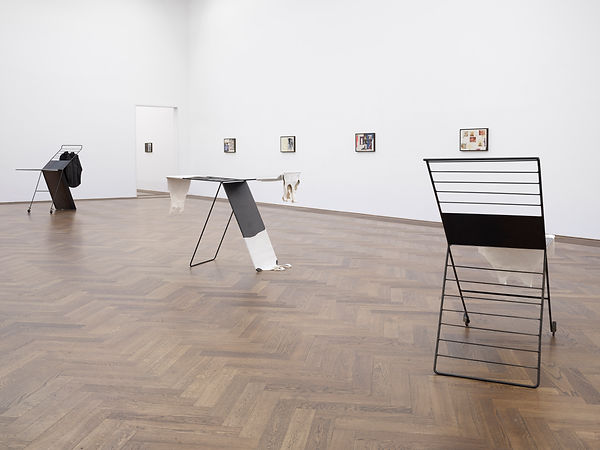
You not only work with images, photographs from public collections or private captures, family pictures, but also with objects, drying racks with laundry hanging, chairs that you place next to your collages, and even entire rooms. Can you explain the concept behind this a bit?
Throughout my exhibitions, and most recently at Kunsthalle Basel, I find myself returning to the reality of life lived inside the home and its contrast with exterior perception. I also interested in the gendered labor performed there, the duties and rituals organized around chores. The drying racks and laundry reference past generations in my lineage. Black, Mexican, and Indigenous workers who maintained difficult jobs as domestics and smelter laborers. It is that determination, labor, and sacrifice that has made my current existence possible.
The chairs became a way to think about a photo album outside of its traditional book form. Chairs are interesting in that they hold multiple meanings at once: sedentary life, individual comfort, and power structures like the hierarchy of thrones. These objects and sculptures provide a setting to sparks dialogue with the wall works.

In your collages, you work with needle and thread, paper clips, but also ink or acrylic paint. What is the relationship between these materials and your theme?
The materials for my projects are heavily reliant on the research, material histories, and intuition. Part of looking into the past requires a certain kind of listening. I attribute this to something Alice Walker describes as crucial in writing: a willingness to seek out where the silence is and understand it. For me, that listening is a form of map-making. Plotting locations, landmarking, revisiting narratives that linger in the present, then going back
to find the gaps and silences.
There is an archaeological impulse in this. A wandering but never aimless researcher surveying the land for signs of past life. There is care in building out the excavation site, careful digging by centimeter, then sifting for what interesting fragments remain. Intuitively deciding what feels important enough to bring forward. The past is very much present for me and I honor that by holding space, encountering the ethos imbedded in the ephemera of past lives. It is my surrender to that anachronism that determines a projects purview. It is very similar to drawing. Building in surrender to the commitment to find form.
My last project was largely based on the disruptive history of the zoot suit and the inherent politics of self fashioning. The language of the tailor, the seamstress, the techniques of garment construction felt important to fully convey that narrative. For this newer project, the physicality of the photo albums and scrapbooks, determined the materials. Various papers, photo album inserts, spiral binding, mounting tabs, and photographs determine the language through which I can enter this narrative. The acrylics allow me to build layers to draw over magazine pages or hand-color photographs, referencing early techniques from the mid-nineteenth to twentieth century using ink and watercolor.
The sewing was carried over from the previous project. I keep returning to the sewing machine as a tool for drawing. There is something inherently disruptive about repurposing it upon materials it was never meant for, the line it makes both gestural and constrained by the machine's own logic. Whether by hand or machine, the sewn line speaks of process and time. In this project it becomes a gesture toward mending and reconciliation. Stitches and sutures either lose their tension or unravel with time.


Is there a connection between the objects you presented in "The Jawbone Sings The Blue," the exhibition at Kunsthalle Basel, and the objects you use in some of your collages?
In recent exhibitions at Company and Kunsthalle Basel, I found myself attentive to binary of domestic spaces. The way that walls divide and designate space for various functions, and how objects inform and date interior settings.
Before the professionalization of the funeral industry, the traditional living room was sometimes used as a funerary viewing space, a place where the dead were laid out and the community gathered to grieve. The room was eventually renamed the living room, a deliberate act of forgetting, an effort to move death out of the domestic and into the institutional. Certain architectural elements like windows and radiators could function as thresholds, both the physical and psychological. The windows locate the viewer in the act of viewing and being viewed, looking in or looking outward, interior and exterior. The radiators interested me differently, as impressions of temperature, objects that belong to another time and still hold the memory of heat.
There is also an element of sadness woven throughout the exhibition. Barthé's scrapbooks carried the particular grief of a life edited for survival, a story shaped around what the world is willing to receive. That made me think about the ways queer people cannot tell their true stories within the constraints of normative respectability politics. That editing and that grief are the same gesture made across different lives.
The installation titled, The Devil’s kitchen, in Kunsthalle’s gallery three, becomes the hearth of the show. But instead of warmth there is a clinical and mysterious setting. Draped furniture with canvas adorned by cropped facsimiles of collage works in the show. The swatches of figures become placeholders for the family’s absence.
Thank you, Troy!

All photos are installation views of the exhibition “The Jawbone Sings Blue” at Kunsthalle Basel, Switzerland, 25 October 2025 - 25 January 2026.
Photo credit: Kunsthalle Basel, Troy Michie Montes
Dominique White: „All Great Powers Collapse from the Centre
an Black Atlantic exhibition at Kunsthalle Basel
by Joas Nebe

The exhibition spaces have been darkened intentionally, with ceiling lights shrouded, allowing both the rooms and the installations to be accentuated by focused spotlights. In this immersive environment, the artist transports us back to the era of the transatlantic slave trade during the 17th century, a harrowing chapter in history that saw the involvement not only of American shipowners but also countless Europeans and, significantly, Africans themselves. Within the cargo hold of those sailing vessels, under inhumane conditions, several hundred, at times even thousands, of Black individuals were crammed together and subjected to transport across the Atlantic for weeks or months, enduring abject circumstances. These individuals were regarded less as human beings and more as commodities, serving as investments requiring protection both from the traders—the slave dealers—and the buyers.
Such an egregious form of exploitation, fundamentally rooted in a white-supremacy racism that deems all non-white races inferior, illustrates the reduction of human beings to mere sources of labor, akin to the role of a workhorse.

The artist's ancestors were forcibly taken to Jamaica in this manner and subsequently returned to England after the conclusion of World War II, with the purpose of contributing to the reconstruction of the devastation experienced in the United Kingdom. This familial background serves as a pivotal point of reference for the artist, who endeavors to create a nuanced representation of this heritage during her solo exhibition at the Kunsthalle Basel.

Beginning with her research into the transatlantic slave trade, White uncovers centuries-old legal documents pertaining to a case of insurance fraud. The “cargo”—namely, the human freight—was, of course, insured, as any prudent merchant would do; institutions such as Lloyd’s, one of the initial marine underwriters, presumably offered such policies. The case that captures White’s attention involves blatant insurance fraud: a ship laden with Black individuals encounters distress at sea and deviates from its course. The crew, faced with an overcrowded situation, makes a conscious decision to lighten the load by casting Black individuals overboard, a deliberate act aimed at saving their own lives. Despite having lost part of the cargo, the shipment eventually reaches its destination, yet the shipowner still seeks compensation from the insurer, a situation inevitably leading to legal proceedings—a testament to the enduring nature of insurance fraud through the ages.
While such incidents might seem typical for that era, what distinctly sets this case apart is the unprecedented reference in legal documents to human beings rather than mere “cargo.”
This context aligns with the time of Melville’s Moby-Dick, the age of perilous mercantile ventures and whalers setting out in small vessels to confront titanic creatures of the sea. During an era when maritime law barely existed in its infancy—offshore and coastal waters alike—control of the seas belonged to those wielding the most manpower and firepower, with slave traders commanding massive vessels that ruled the Atlantic.

However difficult it may be to immerse oneself in such a historical past, which always serves as a canvas for projecting contemporary experiences—a fact acknowledged by every historian—insight can be gleaned, albeit contingent upon sources and the subjective openness of the author. Past events are indeed behind us. Navigating this territory proves treacherous, much like traversing uncharted shallows, yet Dominique White discovers a method to transcend these challenges. She elevates the level of abstraction within her artwork, employing decayed fragments, crafted not from remnants but newly fashioned in Italy by skilled artisans. Curved hull portions and distorted steel rods emerge as symbols. Historically, steel components served only as connecting pieces on brigs and schooners given their expense, while most vessels were constructed of wood—though that detail pales in comparison to White’s aim of creating a metaphor relevant to contemporary times, wherein steel ships are manufactured from structural beams expected to endure for four decades, only to be corroded and scrapped at bargain prices in distant locales like India.

Consequently, White weaves a narrative that recounts her ancestors’ historical abduction, while maintaining sufficient abstraction to resonate with our own experiences. We confront the images of slave ships run aground, their riggings rotting, and hulls lying in ruins—an experience encapsulated in the exhibition presented by White at Kunsthalle Basel.

Dominique White: „All Great Powers Collapse from the Centre
13 February - 17 May 2026
Kunsthalle Basel
Steinenberg 7 CH-4051
Basel, Switzerland
Di/Mi/Fr: 11 – 18 Uhr
Do: 11 – 20:30 Uhr
Sa/So: 11 – 17 Uhr
+41 61 206 99 00
info@kunsthallebasel.ch
https://kunsthallebasel.ch/de/
Photos: Kunsthalle Basel/Dominique White

Diambe: Bees beings beans
by Joas Nebe
Diambe, a non-binary artist hailing from São Paulo, Brazil, presents a compelling exhibition at Kunsthalle Basel. In this noteworthy exploration, Diambe delves into the functional dynamics of collectives, epitomized by the behavior of a beehive, while simultaneously investigating the resistances arising from human interventions and the potential for control over such forces. These intricate themes converge in the video piece entitled "Cera perdida | Lost wax, 2025," showcased in Basel.
In this work, a beehive encounters a wax casting comprised of residues from a variety of tropical and non-tropical fruits, subjected to this influence over the span of hours. "Cera Perdida," born during the artist's residence at Lake Geneva (La Becque Résidence d'Artiste), represents a platform dedicated to nurturing artists who intertwine the realms of nature, technology, and contemporary political discourse.

The video "Cera Perdida," alongside its poignant depiction of a form lost, captures, through an overhead lens, a sculptural entity crafted from beeswax, positioned at the periphery of Lake Geneva within the residency grounds, where exposure to both sunlight and natural elements unfolds, particularly through the presence of bees. Diambe, an urban dweller residing on the twelfth floor of a skyscraper in São Paulo, presents a work emerging from the wax impression of an assemblage—composed of diverse fruits such as corn cobs and coconut shells—rendered into a singular wax form reflecting the very composition derived from nature.

Visually manifesting are the tall grasses and sunbeams, which initially illuminate the beeswax sculpture from above and, over time, shift to a lateral angle. Bees are drawn to this creation, nibbling away at the sugary coating enveloping the sculpture, extracting pieces in their quest for sustenance, resulting in an increasingly precarious state of the artwork as it ultimately succumbs to collapse. This sculpture, neither a traditional artistic form nor a monument to a general, king, emperor, or any other figure elevated upon a pedestal—first the horse, followed by the pedestal itself, raising above measure—stands in stark contrast; instead, what emerges here is a sculpture already dislodged from its pedestal and subjected to dimensions dictated by the bees.

Moreover, the material employed is one that, more fragile than fleeting, succumbs to even the slightest fluctuations in temperature. Thus, an end to grandiosity is observed—the cessation of a dictator, an emperor, or a president in a metaphorical sense.
What endures is the unfettered collaboration of a collective, free from political (leftist) valuation, a partnership echoing the principles found within the natural sciences, elucidating the interconnections and cycles inherent to nature, as highlighted by the melting influence of the beehive and the sun's rays upon the sculpture. Ultimately, what remains is a testament to these very physical, natural processes, to which humanity itself remains submissive.
23 January - 12 April 2026
Kunsthalle Basel
Steinenberg 7
CH-4051 Basel
Switzerland
Tuesday, Wednesday, Friday
11- 18h
Do 11- 2030h
Saturday, Sunday, 11am - 5pm
+41 61 206 99 00
Photo credit:
Courtesy Dianne, Simoes de Assis, Sao Paulo, BR, Kunsthalle Basel.